


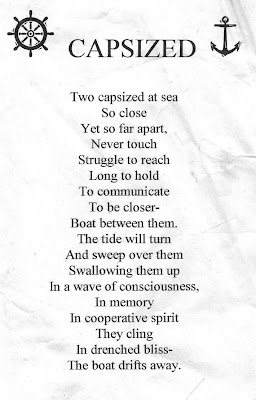
 I had to dig through my hard drive to find this. This was my last poem I wrote. I wrote it about a week and a half after my divorce was final. I think of it as closure. Until that point I had not given up on the hope my ex and I would get back together. No sooner than I wrote that,
  someone I had never met before messaged me online. I never really thought much about it. I was not looking for a relationship. Now here it is over a year and a half later, and we are still together. Further, in the past six months or so, I have had the opportunity to salvage at least some of the friendship with my ex. At least we have been able to talk out a lot of the residual issues left over from our failed life together. Reminds me... this photo was my ex's idea.. it is funny albeit quite awkward.




Honesty is the human quality of communicating and acting truthfully related to truth as a value. This includes listening, and any action in the human repertoire — as well as speaking.
Superficially, honesty means simply stating facts and views as best one truly believes them to be. It includes both honesty to others, and to oneself (see: self-deception) and about one's own motives and inner reality. Honesty, at times, has the ability to cause misfortune to the person who displays it. Honesty can also mean fairness, and truthfulness, and the avoidance of misleading people.
The Western Concept of Honesty
The concept of honesty applies to all behaviors. One cannot refuse to consider factual information, for example, and still claim that one's knowledge, belief, or position is an attempt to be truthful or is held in "good faith." Such willful blindness is clearly a product of one's desires and simply has nothing to do with the human ability to know. Basing one's positions on what one wants — rather than unbiased evidence gathering — is dishonest even when good intentions can be cited — after all even villains could cite good intentions and intended glory for a select group of people. Clearly then, an unbiased approach to the truth is a requirement of honesty.
Because intentions are closely related to fairness, and certainly affect the degree of honesty/dishonesty, there is a widespread confusion about honesty. There is also a general belief that one is necessarily aware that dishonest behavior is dishonest. But it's at the moment when one willfully disregards information in order to benefit (such as to justify their actions or beliefs) that one shows whether they are interested in the truth or whether they have a lack of respect for the truth, which is dishonesty, regardless of whether they mislabel it stubbornness or conviction. Socrates had much to say about truth, honesty and morality, and explained that if people really understood that their behavior was wrong — then they simply would not choose it. Furthermore, the more dishonest someone is, the less likely they are to understand honesty and to characterize their behavior as wrong. Unfortunately,the meaning of honesty has been marginalized to specific lists of behaviors that more often than not --change over time like fashion. The understanding that honesty requires an unbiased approach to the truth and to evidence gathering at all times (a timeless approach) collides with ideologies of all types. This would explain why honesty, although often discussed -- has failed to become a cultural norm. Ideologies and idealism inherently exaggerate and suppress evidence in order to support their perspectives. They essentially state that their way is the only right way to view the world. This erodes the practice and understanding of honesty and creates ongoing conflicts in all human relationships.
Okay, honestly, I just cut and pasted the previous. It was a lot easier that way, and it allows me to move on.
I have been struggling with honestly a lot lately. No so much that I am having a hard time telling the truth, to the contrary... I am having a difficult time keeping my big mouth shut. I gave up on lies several years back... as a result, I hurt other's feelings a lot. I always seem to say the wrong thing. I do not seem to possess as much tact as I perhaps should.
So, here I am, in a relationship, looking for work, and dealing with a whole lot of stuff I would rather not have to. OOps... That kinda came out wrong. I have a lot on my plate right now, a lot of stress. It is largely related to my lack of employment and my difficulty paying bills. I am looking for work, and that is stressful, and I am in a relationship. When I said there was a lot of stuff I did not want to deal with right now, I was referring to everything BUT my relationship with Corrie. That, while not perfect, is the one thing in my life that makes it worthwhile to get up in the morning. If it were not for her, I would be facing my problems alone, and to be honest, I would rather face them with her. She gives me a lot of strength and courage.
Anyway, Honesty. Honesty is one of the things about her that I admire so completely. She seems unable to lie. Her direct and forthright way of speaking her mind is totally refreshing. No bullshit, no guessing, waiting for the other shoe to drop. I would tend to say that in her I have found a woman who has no malice in her heart (unless you are a clown... she hates those). I don't blame her. Which reminds me... did you hear about the cannibals? They will not eat clowns because they smell funny.

 My girlfriend and I were out grocery shopping yesterday afternoon, and we had her 8 year old son with us. It was a day where nothing had been going smoothly, and so perhaps tolerance levels were not as high as they might be normally. Be that as it may, here it is dinner time, we had finished shopping, and had stopped by Wendy's for a couple burgers because Corrie did not really feel up to cooking. Everything is going well... until we pull back out onto the Avenue and turn towards home. Suddenly, there before our eyes is a 4 foot by 8 foot depiction of a physician's hand in rubber glove holding a small, completely formed, but eviscerated fetus. This billboard was being held for all to see by a woman probably in her 50's. She is obviously aware of her protected status under the constitution to display this horrid image to all passersby on this very busy public road.


Observation 1
Apples and
I think that this entry will be the first of a five part series dedicated to a verbose rambling on the subject of something I know very little about. Women. Oh yeah, this should be fun. Not that I will reveal anything particularly profound, earth shaking, or even relevant. It is a good thing that I am not married right now, as anything I say could and would be held against me. This is why I like to sprinkle my conversations with words and phrases like 'breasts', 'nipples', 'ass', and "fish taco', in the hope that these things actually will be held against me. But, it is counterproductive in that the more I use these words and phrases in casual conversation, the less likely it is that I will ever see them again. That may be part of how the phrase "Life's a Bitch, and then you marry one" came about. Wait... don't rush in to Safeway to stock up on eggs and produce to throw at me yet. (I might like that, and you know Safeway will love the business!)
In truth, I am typing this now when I should in fact be working on my homework. Anything to avoid my responsibilities. But my homework is not a part of the curricula of an institution of higher learning. There are no grades, the deadlines are somewhat flexible, and you will find no female coeds (flexible or otherwise... DAMN!!) at my weekly class. But, due to circumstances, I am obliged to attend these classes, there are certain assignments I have to complete before I can "graduate", and I am actually learning quite a bit in spite of myself. It really is too bad about the lack of flexible female coeds though! It is probably for the best I suppose since what brought myself and the other men together in the first place was our relationships with women. Why is it that something with the promise of so much fun turns out to be such a pain in the butt? I mean, here we are, everything is going along, status quo, we have our jobs, our buddies, and Monday Night Football and things are good. We are the masters of our own lives, until one day something new crosses our field of vision, and we willingly run away from everything we know to get a closer look. We barely glance back at our buddies who in our absence are still quaffing mass quantities of our beer while watching our big screen tv, and who barely notice we are gone until the beer runs out or the game is over (whichever comes first). Nope... our buddies may drink and eat us out of house and home, and burn a hole in our sofa while trying to light a fart, but they will still be our buddies later, so we run after this new thing forgetting all about our buddies for awhile.
Then we catch up to the target of our distraction, only to find out that not only do they look good, much softer than our buddies... well, maybe with the exception of Frank... and they smell so good..... intoxicating even.... that all reason (the little we had in the first place) leaves us. We haphazardly throw all caution to the wind and begin to behave even more stupidly than we do normally.
Around our buddies, we are free to be our normal disgusting selves. We scratch, we belch, we scratch again. We laugh at farts, doggoneit! They are funny after all. They are fun. According to George Carlin, they are "Shit without the mess". We lie about our conquests with great abandon since our buddies all know that we are full of shit anyway, it really does not matter. They will never think any less of us if we lie about sex. After all, they do it too! But the problem with lying about sex to our buddies is that sooner or later, we have to at least make an effort to hang with someone with a higher voice than ours. Someone besides Frank that is. It does not matter how cute he looks in polyester, he is after all a buddy, and we overlook such things, right? Okay, maybe not. But if not for Frank, we’d have no one to duct tape to the fridge door in the garage. Don’t worry… he likes it. Besides, as the only one of us who is married and therefore the only one of us who actually gets stank on the hang low with any regularity, he deserves the abuse. Fucking Frank!
As I am writing this, it occurs to me that I may be just a little over the top. I think that a couple things might happen. One, this is intended to be funny, but may possibly offend one or two people with higher voices than mine. (Frank not withstanding) To them, because I am basking in the relative safety of the internet, I say “get over it!” I kinda want the reaction. In person, I am fairly outspoken, but incredibly shy about certain things. I have a problem with keeping my mouth shut, and spend a lot of time dining on “filet o Birk”. But it occurred to me today, why not write? Put it out there online, maybe amuse a few people, and channel my humor to the internet where it may get me in less trouble at home. Besides, maybe if I do catch the attention of the public, find myself an audience, maybe I can share some of the more serious stuff too. I would like to think that there is more to me than meets the eye, and that I have a lot of stuff to offer people. Two, my biggest concern, I may find myself in trouble with people I do not know. My family and friends are more or less accustomed to the weird, off the wall shit that comes out of my mouth on a daily basis. Hopefully more people are entertained than not. Remember, the comments are available to everyone, and I have posted my email, so there really is no excuse why you cannot share your thoughts as well. Looking forward to hearing from each of you.


| I have not been blogging as well as I might like, nor have I been journaling in my journals as frequently as I perhaps should. As a result, life passes byunnoticed. Not that I live a particularly exciting or noteworthy life but I feel that I should document at least some of it. Then again, who would read it? Ah well.... this blog is essentially intended for my family and friends and sinceI talk to neither as often as I should it is perhaps the only way they will know what is going on with me in my life. There it is. In a nutshell, my mission What is on my mind this morning is a conversation I had last night. I had gone to church, and even though I have been running on empty, physically, spiritually, financially and emotionally, I did muster up enough energy to pay attention to the sermon. (barely) The pastor talked about Ecclesiology; The branch of theology that is concerned with the nature, constitution, and functions of a church. Yeah, yeah... I know..... (SNORE) But let me cut to the chase. Fast forward, snip for brevity, and mention the one thing that stands out most in my mind as it is, verbatim, something I have been saying for years; "Love is a Choice." I have been also saying that I do not believe that people "fall" in love. I believe that the initial attraction, or lust, is just that.... purely physical, purely selfish, purley sexual. But, after that, you have a choice, and should you choose to love, then you can work towards growing into love. It takes a conscious effort, a committed decision, and a lot of work, especially if you are trying to do love by the numbers... as God intended. Numbers? Oh yeah.... numbers.... sorry. Number 1. (Mt 22:37-40)Love the Lord your God with all your heart Jesus replied: " 'Love the Lord your God with all your heart and with all your soul and with all your mind.' This is the first and greatest commandment. Number 2 Ephesians 5:25-27 Husbands, love your wives, just as Christ also loved the church and gave Himself up for her; 26 that He might sanctify her, having cleansed her by the washing of water with the word, 27 that He might present to Himself the church in all her glory, having no spot or wrinkle or any such thing; but that she should be holy and blameless. Number 3. 8"'Do not seek revenge or bear a grudge against one of your people, but love your neighbor as yourself. I am the LORD. By the numbers, we are instructed to love God our spouses, and our neighbors. Basically in that order. So.... how are we to Love God with all that we are, love our spouses as Christ loved the Church, and love our neighbors as ourselves? Seems to me like it is a tall order... especially if you knew my neighbors! LOL But, I digress, there is only one way. We have to choose to love, and put it all into God's Hands. Nothing worthwhile is easy, and generally, you have to make sacrifices. That's life. Anyway... as I was saying, I had a conversation last night following the service, and all of this was rummaging around in the back of my mind. In any case, the jist of this conversation with someone I am growing to care about was this: In typical fashion, women tend to be more ready emotionally than men when it comes to love and relationships. Men, on the other hand, tend to be less willing to open themselves up to the possibility. This is because of the primary difference between men and women being , essentially, apples and oranges. Men are physical, while women are emotional. So, it is not uncommon for a woman to say "I love you" first. Men may say it, but I am willing to bet that a lot of first "I Love You's" from men occur during sex. It seems like such a waste of those three very powerful words since in that instance they are merely empty words. Now here it is; I was talking about this with someone I am growing fond of, and I see great potential for a future together whether as friends, or as something more, but have not decided that direction yet. But... I do not want to mess up either possibility. I do not want to jeopardize a wonderful friendship by moving too quickly, and I do not want to screw up the "something more" by also moving too quickly, or not moving at all. Damn quandries! So what does one do? Beats the Hell out of me.... I simply do not know. What I do know is this: I already fucked up several friendships, and a marriage by being selfish, inconsiderate, unthoughthtful, disinterested, dishonest, and short sighted. I am not willing to say the words if they are only empty words. I want to be able to mean it when I do say them. I want to try always to put God first, or at the very least, include Him in the realtionship. Being human, this is not easy. I want to employ everything I have learned from my past to ensure that this woman and I have a fighting chance no matter which way our relationship goes. But, all that aside, I really have to say, it feels really good spending time with her.It feels even better knowing that for the first time in my life I have been completely honest, no secrets, and have let my guard down intentionally that I might let her in. While it has been a challenge so far it has also been somewhat of a catharsis. I basically am feeling pretty good about things, and my life in general, and that, too, is a change for me. It is about time for a positive change in my life. |

*Diabetes Insipidus is not the same as diabetes mellitus ("sugar" diabetes). Diabetes Insipidus resembles diabetes mellitus because the symptoms of both diseases are increased urination and thirst. However, in every other respect, including the causes and treatment of the disorders, the diseases are completely unrelated. Sometimes diabetes insipidus is referred to as "water" diabetes to distinguish it from the more common diabetes mellitus or "sugar" diabetes.
*Diabetes Insipidus is divided into four types, each of which has a different cause and must be treated differently. The most common type of DI is caused by a lack of vasopressin, a hormone that normally acts upon the kidney to reduce urine output by increasing the concentration of the urine. This type of DI is usually due to the destruction of the back or "posterior" part of the pituitary gland where vasopressin is normally produced. Hence, it is commonly called pituitary DI. It is also known as central or neurogenic DI. The posterior pituitary can be destroyed by a variety of underlying diseases including tumors, infections, head injuries, infiltrations, and various inheritable defects. The latter can be recognized by the onset of the DI in early childhood and a family history of parents, siblings or other relatives with the same disorder. Nearly half the time, however, pituitary DI is "idiopathic" (that is, no cause can be found despite a thorough search including magnetic resonance imaging or MRI of the brain) and the underlying cause(s) is (are) still unknown. Pituitary DI is usually permanent and cannot be cured but the signs and symptoms (i.e. constant thirst, drinking and urination) can be largely or completely eliminated by treatment with various drugs including a modified from of vasopressin known as desmopressin or DDAVP. Because pituitary DI is sometimes associated with abnormalities in other pituitary hormones, tests and sometimes treatments for these other abnormalities are also needed.
*Occasionally, a lack of vasopressin can also develop during pregnancy if the pituitary is slightly damaged and/or the placenta destroys the hormone too rapidly. This second type of vasopressin deficiency is called gestagenic or gestational DI and is also treatable with DDAVP but, in this case, the deficiency and the DI often disappear 4 to 6 weeks after delivery at which time the DDAVP treatment can usually be stopped. Often, however, the signs and symptoms of DI recur with subsequent pregnancies.
*The third type of DI is caused by an inability of the kidneys to respond to the "antidiuretic effect" of normal amounts of vasopressin. This type of DI is usually referred to as nephrogenic DI and can result from a variety of drugs or kidney diseases including heritable genetic defects. It cannot be treated with DDAVP and, depending on the cause, may or may not be curable by eliminating the offending drug or disease. The heritable form, for example, lasts for life and cannot be cured at present. However, there are treatments that can partially relieve the signs and symptoms of nephrogenic DI.
*The fourth form of DI occurs when vasopressin is suppressed by excessive intake of fluids. The latter is usually referred to as primary polydipsia and is most often caused by an abnormality in the part of the brain that regulates thirst. This subtype is called dipsogenic DI and is difficult to differentiate from pituitary DI particularly since the two disorders can result form many of the same brain diseases. The only sure way to tell them apart is to measure vasopressin during a stimulus such as fluid deprivation or to observe the effects of DDAVP treatment. In dipsogenic DI, DDAVP also eliminates the excessive urination but, unlike pituitary DI, it does not completely eliminate the increased thirst and fluid intake. Thus, it also results in water intoxication, a condition associated with symptoms such as headache, loss of appetite, lethargy and nausea and signs such as an abnormally large decrease in the plasma sodium concentration (hyponatremia). Because of this and the current lack of a way to correct the underlying abnormality in thirst, dipsogenic DI cannot be treated at present, although the most troubling symptoms, nocturia, can be safely relieved by taking small doses of DDAVP at bedtime. The other subtype of primary polydipsia is due not to abnormal thirst but to psychosomatic causes and is often referred to as pyschogenic polydipsia. It cannot be treated at present.
QUESTIONS YOU MAY HAVE
What is considered "excessive" urination? What is considered "excessive thirst?
An adult who urinates more than 50mL/kg body weight per 2 hours is generally considered to have a higher than normal output. Loosely translated, 50mL/kg is about 3.5 quarts per day for a 150-lb. adult. an adult who drinks more than 4 quarts (1 gallon) or approximately 12 glasses (144 oz) of beverages per day would have a higher than normal intake.
Does pituitary diabetes insipidus cause any problems other than increased urination, thirst and drinking? Does it shorten one's life span?
As far as we know, pituitary or nephrogenic DI does not cause any other disabilities or health risks provided there is no interference with the ability to replace the loss fluid. If water intake is impaired - for example, by loss of consciousness or by separation from an abundant supply of drinkable water - there is a very grave risk of severe dehydration that could lead to serious brain damage or even death. Treatment reduces this risk because it reduces the rate of water loss and thereby lengthens the time one can go without drinking. However, it does not eliminate the risk altogether because there is always the possibility that the medication will be lost or run out. For this reason, it is important to always carry an adequate supply of medication and be careful about getting in a situation where a good supply of drinking water is not available - for example ocean sailing or hiking in the mountains or desert.
Dipsogenic DI or pyschogenic polydipsia does not carry the risk of dehydration but may result in serious overhydration (water intoxication) if DDAVP or other drugs such as thiazide diuretics are taken or if certain acute diseases such as influenza develop. Therefore, it is important to know if these disorders are present so that the offending drugs can be avoided or the appropriate tests and countermeasures can be applied as soon as a disease or ailment like influenza develops.
If I have pituitary or nephrogenic DI and the symptoms don't bother me, why should I take treatment?
The principle reason is to reduce the risk of severe dehydration and provide greater freedom to participate in activates in which it is difficult, if not impossible to drink and urinate frequently.
Apart from taking DDAVP or other antidiuretic medication, is there anything else I should do?
Yes, you should wear a MedicAlert bracelet and/or carry a MedicAlert card in your wallet so that if you have a medical emergency even a doctor who does not know you will recognize immediately your need for special treatment.
DIABETES MELLITUS: This is also called Sugar Diabetes
Diabetes is a life-long disease marked by high levels of sugar in the blood. It can be caused by too little insulin (a hormone produced by the pancreas to regulate blood sugar), resistance to insulin, or both.

To understand diabetes, it is important to first understand the normal process of food metabolism. Several things happen when food is digested:
People with diabetes have high blood glucose. This is because their pancreas does not make enough insulin or their muscle, fat, and liver cells do not respond to insulin normally, or both.
There are three major types of diabetes:
Diabetes affects about 18 million Americans. There are many risk factors for diabetes, including:
The American Diabetes Association recommends that all adults be screened for diabetes at least every three years. A person at high risk should be screened more often.
High blood levels of glucose can cause several problems, including frequent urination, excessive thirst, hunger, fatigue, weight loss, and blurry vision. However, because type 2 diabetes develops slowly, some people with high blood sugar experience no symptoms at all.
Symptoms of type 1 diabetes:
Symptoms of type 2 diabetes:
A
Patients with type 1 diabetes usually develop symptoms over a short period of time, and the condition is often diagnosed in an emergency setting. In addition to having high glucose levels, acutely ill type 1 diabetics have high levels of ketones.
Ketones are produced by the breakdown of fat and muscle, and they are toxic at high levels. Ketones in the blood cause a condition called "acidosis" (low blood pH). Urine testing detects both glucose and ketones in the urine. Blood glucose levels are also high.
There is no cure for diabetes. The immediate goals are to stabilize your blood sugar and eliminate the symptoms of high blood sugar. The long-term goals of treatment are to prolong life, relieve symptoms, and prevent long-term complications such as heart disease and kidney failure.
LEARN THESE SKILLS
Basic diabetes management skills will help prevent the need for emergency care. These skills include:
After you learn the basics of diabetes care, learn how the disease can cause long-term health problems and the best ways to prevent these problems. People with diabetes need to review and update their knowledge, because new research and improved ways to treat diabetes are constantly being developed.
WHAT TO EAT
You should work closely with your health care provider to learn how much fat, protein, and carbohydrates you need in your diet. Your specific meal plans need to be tailored to your food habits and preferences. People with type 1 diabetes should eat at about the same times each day and try to be consistent with the types of food they choose. This helps to prevent blood sugars from becoming extremely high or low. Type 2 diabetics should follow a well-balanced and low-fat diet.
A registered dietician can be very helpful in planning dietary needs.
Weight management is important to achieving control of diabetes. Some people with type 2 diabetes can stop medications after losing excess weight, although the diabetes is still present.
HOW TO TAKE INSULIN OR ORAL MEDICATION
Medications to treat diabetes include insulin and glucose-lowering pills, called oral hypoglycemic agents. The bodies of people with type 1 diabetes cannot make their own insulin, so daily insulin injections are required. The bodies of people with type 2 diabetes make insulin but cannot use it effectively.
Insulin is not available in oral form. It is delivered by injections that are generally required one to four times per day. Some people use an insulin pump, which is worn at all times and delivers a steady flow of insulin throughout the day.
Insulin preparations differ in how quickly they start to work and how long they remain active. Sometimes different types of insulin are mixed together in a single injection. The types of insulin to use, the doses required, and the number of daily injections are chosen by a health care professional trained to provide diabetes care.
People who need insulin are taught to give themselves injections by their health care providers or diabetes educators.
Unlike type 1 diabetes, type 2 diabetes may respond to treatment with exercise, diet, and/or oral medications. There are several oral hypoglycemic agents that lower blood glucose in type 2 diabetes. They fall into one of three groups:
Most type 2 diabetics will require more than one medication for good blood sugar control within three years of starting their first medication. Different groups of oral medications may be combined, or insulin and oral medications may be used together.
Some people with type 2 diabetes find they no longer need medication if they lose weight and increase activity, because when their ideal weight is reached, their own insulin and a careful diet can control their blood glucose levels.
Oral hypoglycemic agents are not known to be safe for use in pregnancy; women who have type 2 diabetes and take these medications may be switched to insulin during pregnancy and while breast-feeding.
Gestational diabetes is treated with diet and insulin.
SELF-TESTING
Self-monitoring of blood glucose is done by checking the glucose content of a drop of blood. Regular testing tells you how well diet, medication, and exercise are working together to control your diabetes.
The results of the test can be used to adjust meals, activity, or medications to keep blood sugar levels in an appropriate range. Testing provides valuable information for the health care provider and identifies high and low blood sugar levels before serious problems develop.
The American Diabetes Association recommends that premeal blood sugar levels fall in the range of 80 to 120 mg/dL and bedtime blood levels fall in the range of 100 to 140 mg/dL. Your doctor may adjust this depending on your circumstances.
You should also ask your doctor how often to check your
Ketone testing is another test that is used in type 1 diabetes. Ketones build up in the blood when there is not enough insulin in people with type 1 diabetes, eventually "spilling over" into the urine. The ketone test is done on a urine sample. High levels of blood ketones may result in a serious condition called
EXERCISE
Regular exercise is especially important for people with diabetes. It helps with blood sugar control, weight loss, and high blood pressure. People with diabetes who exercise are less likely to experience a heart attack or stroke than diabetics who do not exercise regularly. You should be evaluated by your physician before starting an exercise program.
Here are some exercise considerations:
Changes in exercise intensity or duration may require changes in diet or medication dose to keep blood sugar levels from going too high or low.
People with diabetes are prone to foot problems because of the likelihood of damage to blood vessels and nerves and a decreased ability to fight infection. Problems with blood flow and damage to nerves may cause an injury to the foot to go unnoticed until infection develops. Death of skin and other tissue can occur.
If left untreated, the affected foot may need to be amputated. Diabetes is the most common condition leading to amputations.
To prevent injury to the feet, people with diabetes should adopt a daily routine of checking and caring for the feet as follows:
The risks of long-term complications from diabetes can be reduced.
The Diabetes Control and Complications Trial (DCCT) studied the effects of tight blood sugar control on complications in type 1 diabetes. Patients treated for tight blood glucose control had an average HbA1c of approximately 7%, while patients treated less aggressively had an average HbA1c of about 9%. At the end of the study, the tight blood glucose group had dramatically fewer cases of kidney disease, eye disease, and nervous system disease than the less-aggressively treated patients.
In the United Kingdom Prospective Diabetes Study (UKPDS), researchers followed nearly 4,000 people with type 2 diabetes for 10 years. The study monitored how tight control of blood glucose (HbA1c of 7% or less) and blood pressure (less than 144 over less than 82) could protect a person from the long-term complications of diabetes.
This study found dramatically lower rates of kidney, eye, and nervous system complications in patients with tight control of blood glucose. In addition, there was a significant drop in all diabetes-related deaths, including lower risks of heart attack and stroke. Tight control of blood pressure was also found to lower the risks of heart disease and stroke.
The results of the DCCT and the UKPDS dramatically demonstrate that good blood glucose and blood pressure control, many of the complications of diabetes can be prevented.
Emergency complications include
Long-term complications include:
Go to the emergency room or call the local emergency number (such as 911) if symptoms of ketoacidosis occur:
Go to the emergency room or call the local emergency number if symptoms of extremely low blood sugar (hypoglycemic
Maintaining an ideal body weight and an active lifestyle may prevent the onset of type 2 diabetes. Currently there is no way to prevent type 1 diabetes.


